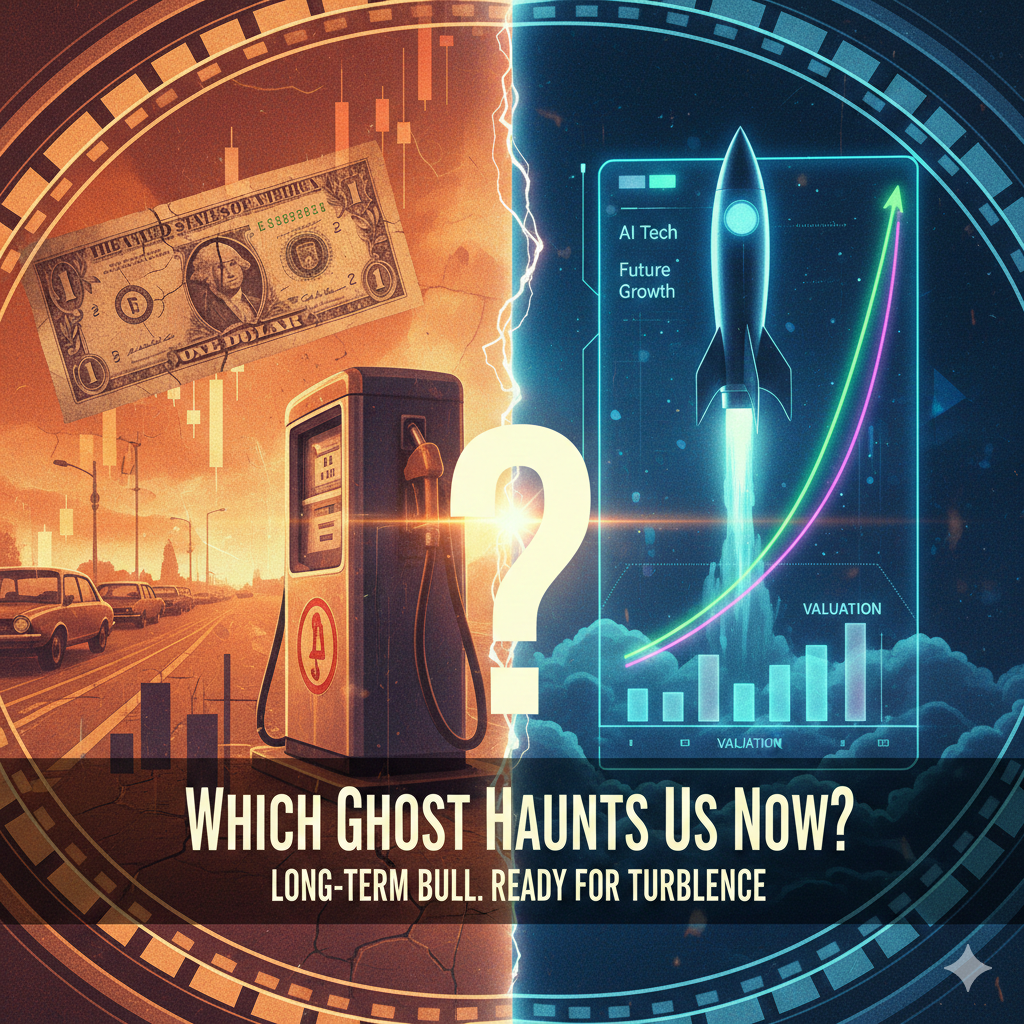
I have always been a long-term bull on the stock market. My belief in human ingenuity and the power of technological advancement remains unshaken. However, being an optimist doesn’t mean being blind to the clouds on the horizon. To protect our wealth and stay in the game for the long haul, we must brace ourselves for potential turbulence and understand the historical cycles we might be facing.
Today, the market seems to be caught between two ghosts of the past: the 1970s Great Inflation and the 2000s Dot-com Bubble. Which one are we dealing with?
1. The 2000s Scenario: The Price of Overpaying (Valuation Risk)
The “Lost Decade” of the early 2000s was primarily a valuation problem.
- The Backdrop: The S&P 500 P/E ratio sat at 30x, while the Nasdaq 100 soared to over 100x.
- The Core Issue: It wasn’t that companies stopped making money; it was that investors had paid too much for “future dreams.”
- The Lesson: This was a slow burn of “multiple compression.” It took a decade for earnings to catch up with the inflated prices. Today’s AI and Big Tech frenzy certainly carry echoes of this era.
2. The 1970s Scenario: The Erosion of Trust (Inflation Risk) ⚠️
While many focus on the bubble, a growing number of analysts warn that we might be closer to the 1970s. This isn’t just a price problem; it’s a currency and cost problem.
- Persistent Inflation: Much like the 1970s oil shocks, today’s geopolitical tensions and supply chain shifts are driving “cost-push” inflation that central banks struggle to control.
- Fiscal Recklessness: Massive government spending continues to fuel liquidity, making it harder for inflation to return to the 2% target.
- The “Real” Tragedy: In the 70s, even if your stocks went up, your real returns were often negative because inflation ate all the gains. It was a time when “holding cash was a risk, and holding stocks was a struggle.”
3. The Hybrid Reality: A New Kind of Challenge
We are currently in a unique “hybrid” environment. We have the high valuations of 2000 colliding with the sticky inflation of the 1970s.
- The AI Wildcard: Unlike the 70s, we have AI—a potential deflationary force that could boost productivity and offset rising costs.
- The Risk: If productivity gains lag behind the pace of inflation, we could face a prolonged period of “high-for-longer” interest rates and stagnant real growth.
[Closing: My Strategy]
As a long-term optimist, I am not selling everything and hiding under a rock. Instead, I am refining my defensive line:
- Gold as Insurance: Not just for profit, but as a hedge against the erosion of purchasing power. Let us have gold at least 10% of your portfolio.
- Focus on Real Returns: I’m looking for companies with strong pricing power and dividend growth that can outpace inflation.
- Staying Balanced: Avoiding “all-in” bets. Diversification is the only free lunch, especially when the ghost of the 70s is knocking on the door.
History doesn’t repeat, but it often rhymes. By understanding these two eras, we can navigate the current fog with a clear head and a steady hand.
Leave a Reply