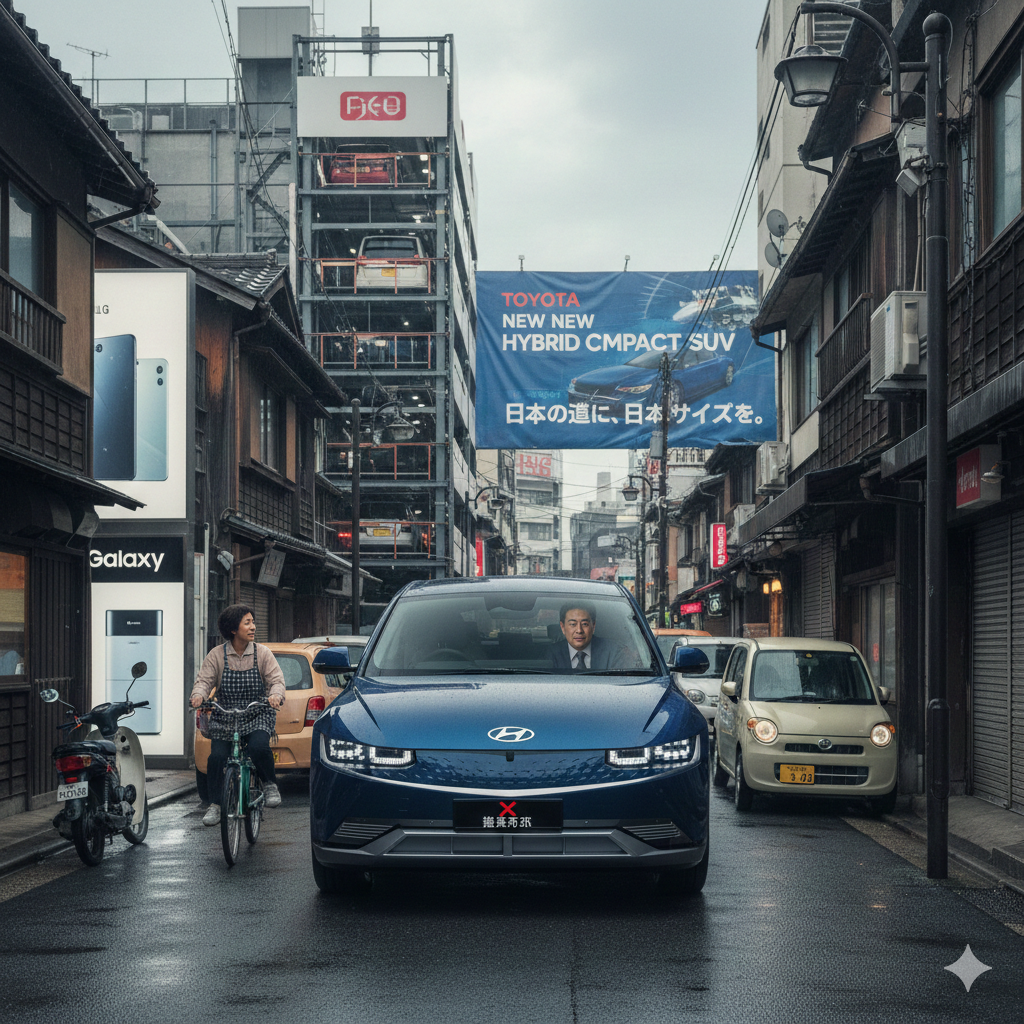
1. The Paradox: Everywhere Else, But Not Here
The Hyundai Motor Group is a global automotive powerhouse, vying with Toyota and Volkswagen for the top three spots in worldwide sales. However, if you have lived in Japan, you have likely wondered: “Where are all the Hyundai cars?”
As a resident of Japan for 8 years, my observation that I haven’t seen a single Hyundai is backed by statistics. Japan is often called the “Graveyard for Imported Cars,” where domestic brands maintain a staggering 90% market share. What is intriguing, however, is that other Korean giants like Samsung (Galaxy) and LG are commonly found in Japanese daily life.
Why has the automotive sector specifically failed to cross the threshold? It isn’t just about origin; it is about a critical lack of strategy.
2. The Lack of Strategy: Two Entries, Two Missteps
Hyundai’s history in Japan is divided into two eras, both of which failed to grasp the core of the local market.
A. The Early 2000s (Initial Entry): “Why Choose Hyundai Over Toyota?” In 2001, Hyundai tried to capitalize on the “Korean Wave” (Hallyu) by using celebrity Bae Yong-joon (Yonsama) as their model. This was a fatal targeting error.
- Targeting Mismatch: The primary buyers of mid-sized sedans like the Sonata were conservative middle-aged men, but the advertising appealed almost exclusively to female fans of Korean dramas.
- Failure of Differentiation: At the time, Hyundai was perceived as a “cheaper version of Toyota.” In a market where Toyota and Honda offered world-class reliability and massive service networks, Japanese consumers saw no reason to buy a Hyundai, which suffered from a poor resale value and a weak service infrastructure.
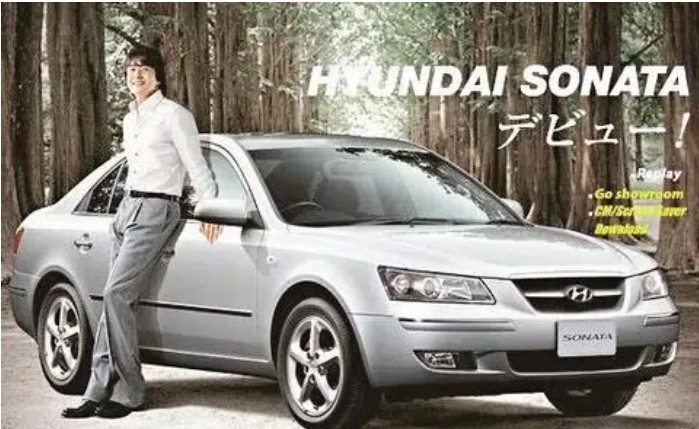
source : NAVER
2) The 2020s (2nd Entry): “Innovation or Misjudgment?” (Failure of Method)
In 2022, Hyundai ambitiously re-entered the market with the electric vehicle IONIQ 5. However, sales in 2023 stopped at less than 500 units,.
(1) Stubbornness on Online Stores vs. Japan’s ‘Omotenashi’
Hyundai declared a 100% online sales strategy, benchmarking Tesla. However, Japan’s car buying culture is based on ‘Omotenashi’ (wholehearted hospitality). Japanese consumers value the ‘relationship,’ preferring to consult with dealers, touch the car in person, and set up meticulous maintenance contracts,.
• Comparison: In contrast, China’s BYD aggressively built an offline dealer network simultaneously with its entry. As a result, it recorded sales three times that of Hyundai in its first full year,. Japanese consumers needed a car where a dealership was “nearby” rather than just “a click away”.
(2) EV Charging Stations and ‘Disaster Anxiety’
Japan is sensitive to power outages caused by natural disasters like earthquakes and typhoons. There is anxiety that Battery Electric Vehicles (BEVs) will stop during blackouts, leading to a preference for Hybrid Electric Vehicles (HEVs) that can run on gasoline. Hyundai bet solely on pure EVs despite insufficient charging infrastructure, but the EV market share in Japan remains narrow, at barely over 1-2%,.
(3) Targeting Failure: The Milenial and Gen Z Don’t Drive
Hyundai targeted the 20s-30s demographic, who are familiar with online sales and have a high affinity for Korean culture,. However, Japanese youth are often referred to as the ‘Satori Generation,’ characterized by low consumption desires and a developed public transport system, resulting in a weak will to own cars. The middle-aged demographic, who actually have the purchasing power for imported cars, still prefer offline services, clashing with Hyundai’s strategy.
3. Why Samsung and LG Succeeded
Unlike Hyundai, Samsung and LG utilized clever survival tactics:
- Samsung (Galaxy): From 2015 to 2023, Samsung removed its corporate logo from products in Japan, branding them simply as “Galaxy.” This allowed the technology to speak for itself without being hindered by geopolitical bias.
While Japan remains an “iPhone stronghold” with Apple maintaining an overwhelming market share of around 50%, Samsung has recently been in a fierce battle for the No. 1 spot in the Android segment, competing closely with Google and local Japanese brands like Sharp and Sony.
📊 Samsung Electronics: Smartphone Market Share Trends in Japan
| Period | Market Share | Market Ranking | Key Events & Highlights |
| 2015 | Approx. 5.0% | Lower Tier | Removed “Samsung” logo (Rebranded to “Galaxy”) |
| 2017 | 3.4% | – | Strategic re-entry period into the Japanese market |
| 2022 | Approx. 10.5% | 2nd | Reached 2nd place driven by Galaxy S22 & Z Flip4 success |
| 2023 | 6–7% | 4th | Ranking declined due to the rapid growth of Google Pixel |
| 2024 Q1 | 10.0% | 3rd | Shipments recovered to 1 million units (first time in 2 years) |
| 2025 Q2 | 10.0% | 3rd | Galaxy S25 success (60% YoY surge in shipment volume) |
| Full Year 2025 | Approx. 6.5–7% | 3rd | No. 1 Android Brand by sales volume (BCN Award 2026) |
・LG: LG targeted Niche Markets. Instead of competing head-on in the crowded TV market, they introduced innovative products like the “Styler” (garment steamer) and premium OLED TVs, creating a “must-have” category that Japanese brands didn’t offer.
4. The Lessons Learned: A New Counterattack
Hyundai and Kia are now pivoting based on these lessons, and the latest data shows positive signs.
- “Small is the Answer”: Hyundai has introduced the Inster (Casper Electric). Designed to fit Japan’s narrow streets and similar to the popular “Kei car” dimensions, it has received rave reviews and is driving a surge in sales.
- B2B and Physical Networks (Kia’s Strategy): Kia is entering in 2025/2026 not with passenger cars, but with PBVs (Purpose-Built Vehicles) like the PV5. By partnering with the Japanese trading giant Sojitz, Kia is securing a B2B foothold with a ready-made dealer and service network.
- Expanding Touchpoints: Hyundai is moving away from its “online-only” stubbornness, opening “Hyundai Mobility Lounges” to meet customers in person.
Conclusion
The struggle of Korean cars in Japan was not simply due to “anti-Korean sentiment,” but rather a supplier-centric strategy that ignored local specificities like the preference for small cars and the importance of face-to-face service. Now, with “Japan-sized cars” (Casper) and “Local partnerships” (Kia-Sojitz), they are finally starting true localization. It will be a fascinating point of observation for residents to see if more of these cars finally appear on Japanese roads over the next few years.
Leave a Reply