
1. Introduction: When the Economic Miracle Ended
In the early 1990s, Japan’s celebrated “economic miracle” came to an abrupt halt with the collapse of the asset price bubble. While international observers focused on declining GDP growth and deflation, a quieter but more enduring crisis was unfolding at home.
Young people who entered the labor market roughly between 1993 and 2005 faced conditions unlike any generation before them. Graduating into what later became known as the Employment Ice Age (就職氷河期), many were unable to secure stable employment at the very start of their careers. Today, they are collectively referred to as Japan’s Lost Generation—not because they lacked ability, but because the system failed them at a critical moment.
2. The Rigidity of Simultaneous Recruitment and the Rise of “Black Companies”
To understand the depth of this problem, it is essential to understand Japan’s hiring structure, especially the Simultaneous Recruitment of New Graduates (新卒一括採用).
- A One-Shot Hiring System
Traditionally, large Japanese firms recruit almost exclusively from a single, synchronized hiring window targeting new graduates. Securing a seishain (regular, permanent) position during this brief period is considered decisive. Missing this opportunity often labels a candidate as “non-standard,” making later entry into stable employment extremely difficult.
・Limited Mid-Career Mobility
During the 1990s and early 2000s, mid-career hiring was rare, and job-switching carried heavy stigma. As a result, many young workers were pushed into irregular employment—temporary, contract, or part-time jobs—with low wages and little job security.
・ The Emergence of “Black Companies”
This structural imbalance created fertile ground for so-called “Black Companies” (ブラック企業)—firms notorious for unpaid overtime, excessive working hours, power harassment, and labor law violations. For many Lost Generation workers, quitting such jobs felt impossible. Leaving often meant falling permanently out of the formal labor market, so they endured extreme conditions until burnout, illness, or psychological collapse.
3. The Numbers Behind the Crisis: The Active Job Openings Ratio
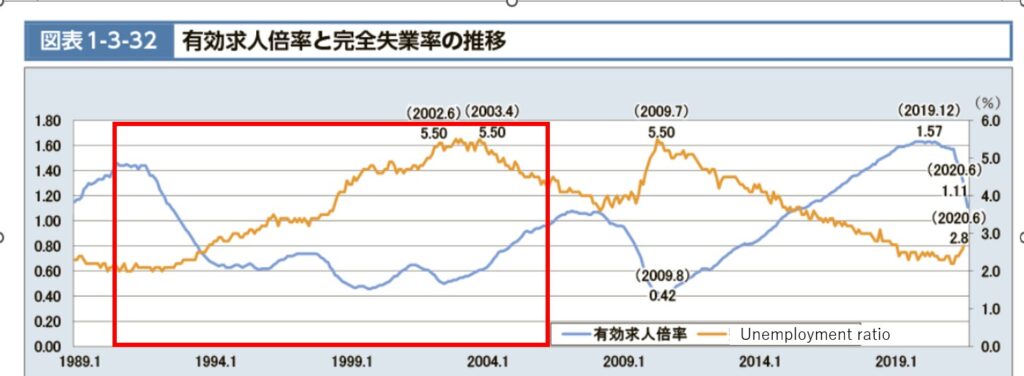
The severity of the Employment Ice Age is clearly reflected in a key labor market indicator: the Active Job Openings-to-Applicants Ratio (有効求人倍率).
What the Ratio Means
This metric measures the number of available jobs relative to the number of registered job seekers.
- A ratio of 1.0 means one job for every applicant.
- Anything below 1.0 indicates more job seekers than openings.
A Historic Collapse
- In 1990, near the peak of the bubble economy, the ratio stood at 1.43, signaling a healthy labor market.
- By 1999, it had fallen to a record low of 0.48. (The year 2009 was an exception due to the Global Financial Crisis.)
In practical terms, this meant fewer than one job for every two applicants. Even highly motivated and capable graduates simply had nowhere to go. This was not a failure of individual effort, but a mathematical bottleneck that shut an entire cohort out of stable career paths.
4. Long-Term Consequences: The “8050 Problem” and Social Isolation
Three decades later, the unresolved damage has evolved into a profound social issue known as the “8050 Problem.” This term describes households where parents in their 80s continue to financially and emotionally support children in their 50s—many of whom belong to the Lost Generation.
Some, after repeated failures in the labor market or traumatic experiences at exploitative workplaces, withdrew from society altogether. These individuals may become hikikomori, living in extreme isolation for years or even decades.
The situation has become a demographic time bomb. As elderly parents pass away, their socially isolated children are often left without income, social networks, or access to support systems. This has contributed to a rise in solitary deaths (孤独死, kodokushi), exposing the human cost of long-term policy inaction.
5. Policy Failures: From Structural Crisis to Personal Blame
One of the most damaging aspects of this period was how the crisis was initially interpreted. For many years, the struggles of the Lost Generation were framed as issues of personal effort, motivation, or resilience rather than structural failure.
By individualizing what was clearly a systemic labor market collapse, policymakers delayed meaningful intervention. Support measures—such as retraining programs, targeted hiring incentives, and social reintegration support—came late and often proved insufficient. Meanwhile, social stigma deepened, compounding economic hardship with long-lasting psychological harm.
6. Conclusion: A Warning Beyond Japan
Japan’s Lost Generation is not merely a domestic issue or a historical footnote. It is a cautionary tale for all advanced economies. Rigid hiring systems, weak safety nets, and the social marginalization of the unemployed can turn a temporary recession into a permanent generational divide.
As today’s economies confront the expansion of the gig economy, AI-driven labor disruption, and increasingly precarious work, Japan’s experience offers a clear lesson:
when systems fail at the point of entry, an entire generation may never fully recover.
Leave a Reply