
For decades, Japan was the global poster child for economic equality. We called it the “100 Million Middle Class” (Ichioku So-churyu)—a society where 90% of people felt they belonged to a stable, comfortable middle tier.
But as of 2026, that myth has officially shattered. If you’re living in Japan today, you can feel it: the prices at the supermarket are climbing, while the value of the Yen in your savings account is melting away.
Here is why the “Gap Society” (Kakusa Shakai) is the new reality, and why investing has shifted from a “choice” to a “survival strategy.”
1. The Great Divide: From Equality to “Gap Society”
The numbers don’t lie. The gap between the “haves” and “have-nots” is widening at a structural level.
- The Gini Coefficient Crisis: This measure of inequality rose from 0.38 in the 80s to a staggering 0.56 recently. When you look at financial wealth, it hits 0.67.
- The Shrinking Middle: Japan’s middle class is now smaller than the OECD average. The security once guaranteed by “lifetime employment” has been replaced by irregular jobs and a demographic shift that favors asset holders over wage earners.
2. The Inflation Trap: Why Your Salary Feels Smaller
After 30 years of “frozen” prices (deflation), Japan is facing a new enemy: Persistent Inflation.
- The Real Wage Gap: As of late 2025, real wages have dropped for nearly a year straight. Even if your boss gives you a small raise, it’s being devoured by a 3.3% rise in consumer prices.
- The “Cash Penalty”: With the Yen hitting 37-year lows, holding wealth strictly in cash is essentially a slow leak in your financial bucket.
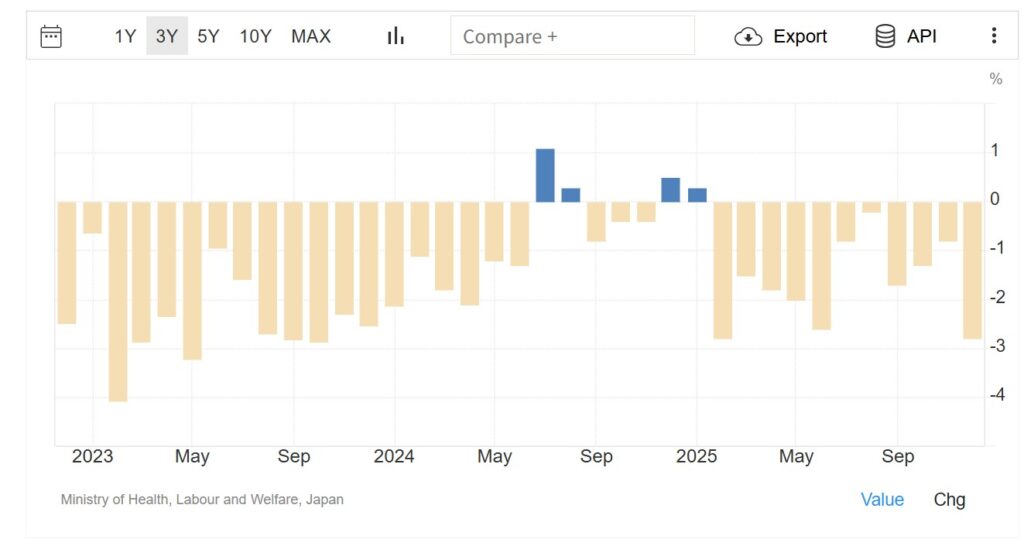
Real income has been falling for three consecutive years.
(Source: https://ko.tradingeconomics.com/japan/real-earnings-including-bonuses)
3. The “Asset Bifurcation”: Winners vs. Losers
There is a massive divergence happening in the Japanese market.
- The Asset Holders: Driven by NISA expansions and corporate reforms, the Nikkei and Tokyo real estate markets have boomed. The “super-rich” in Japan saw their net worth triple over the last decade.
- The Zero-Savings Reality: On the flip side, roughly 30% of single-person households now report having zero savings. They have no buffer against the rising cost of living.
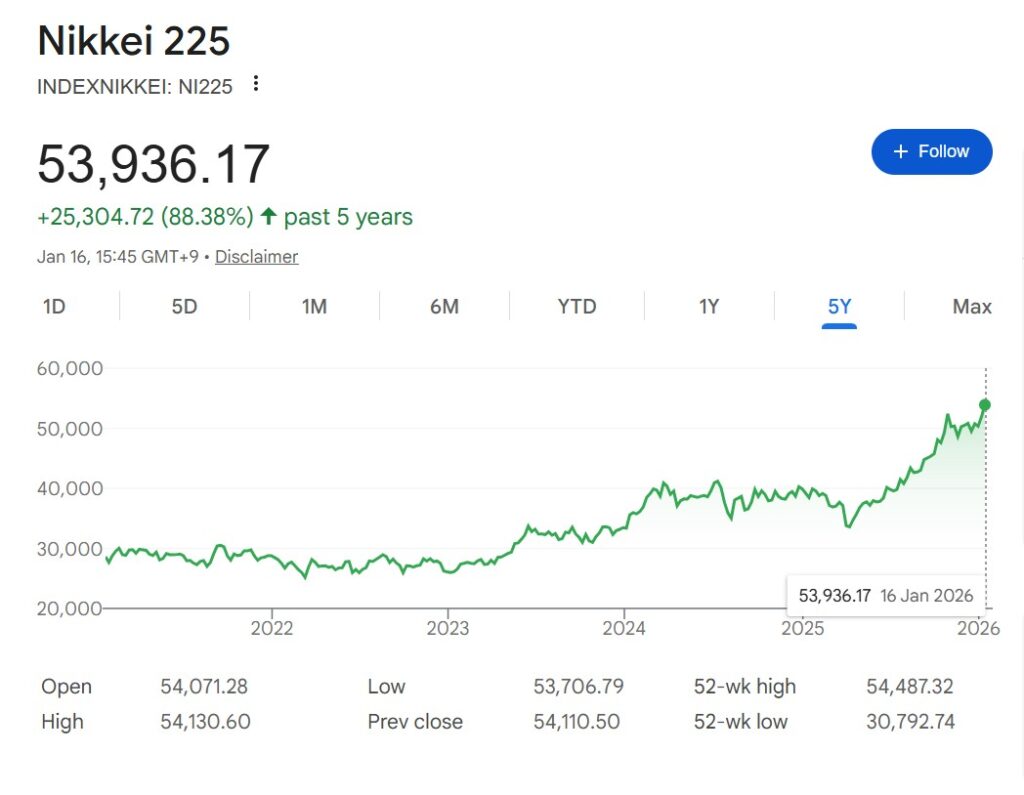
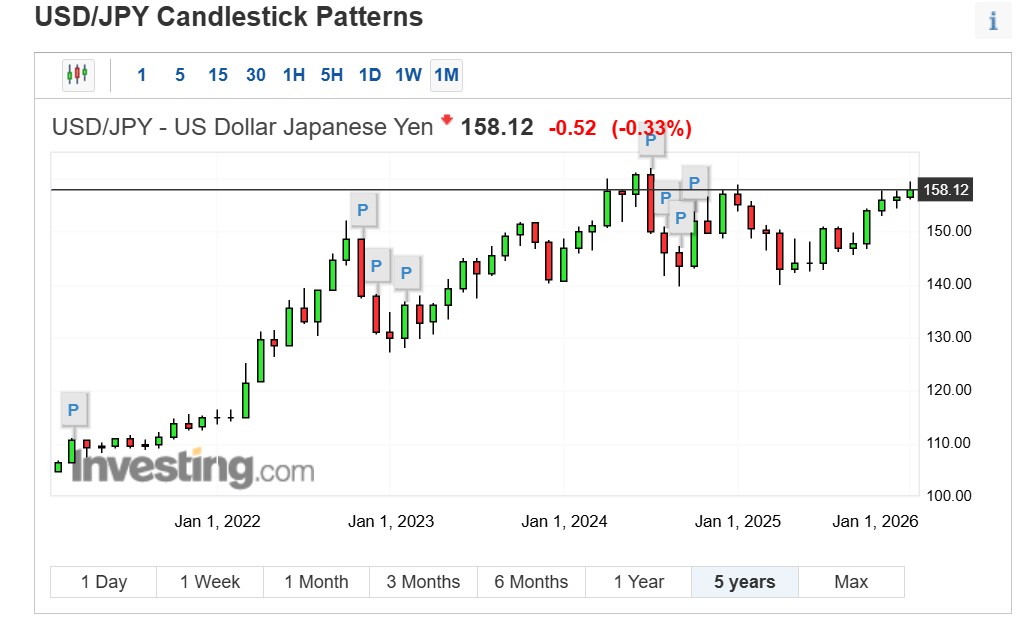
Stock prices have surged by almost 90% in five years, yet the Yen’s value has plummeted by 50% against the Dollar, moving from 104 to 158 since January 2021
4. Looking Ahead: “Sanaenomics” and the Future
Under Prime Minister Sanae Takaichi, the “Takaichi Trade” is in full swing. With massive stimulus packages and interest rates hitting 27-year highs, the volatility is real.
- Fiscal Expansion: The government is spending big to manage the crisis, but this puts more pressure on the Yen.
- The Verdict: In an era of high debt and “Sanaenomics,” the devaluation of cash is almost guaranteed.
Conclusion: Investment is the New Defense
The “100 Million Middle Class” was a beautiful era, but it’s over. In today’s Japan, simply working hard and saving cash is a losing strategy. To protect your purchasing power and your family’s future, shifting from “Savings to Investment” is no longer about getting rich—it’s about staying afloat.
Sources & Citations
- Data on Inequality: Ministry of Health, Labour and Welfare (Wage Statistics) & Cabinet Office (Gini Coefficient Trends).
- Economic Analysis: Toshiaki Tachibanaki, Economic Inequality in Japan; Toshiki Sato, Inequality Society Japan.
- Market Data: 2025-2026 Inflation and Real Wage reports from the Statistics Bureau of Japan.
- Policy Context: Analysis of “Sanaenomics” and 2025-2026 Fiscal Stimulus packages.
Leave a Reply