If you travel between Seoul, Tokyo, and Beijing, you’ll notice a shared visual foundation: Chinese characters (known as Hanja in Korea, Kanji in Japan, and Hanzi in China). To an outside observer, it looks like a unified linguistic zone. However, relying on the literal meaning of these symbols can lead to hilarious—or incredibly awkward—misunderstandings.
In linguistics, these are known as “False Friends” (homographs). They look identical on paper, but their meanings have drifted apart over centuries of cultural isolation.
Here are six common terms that look the same but mean something completely different across the borders.
1. 放心
The characters literally mean “to set the heart down,” but how that heart is set depends on where you are standing.
- In Korea (Bang-sim): It is a warning. It means “to let your guard down” or be careless.
- In China (fàngxīn): It is a comfort. It means “to be at ease” or “don’t worry.”
- The Trap: Telling a Chinese colleague “Don’t fàngxīn” might sound like you’re telling them “Never be at peace!”
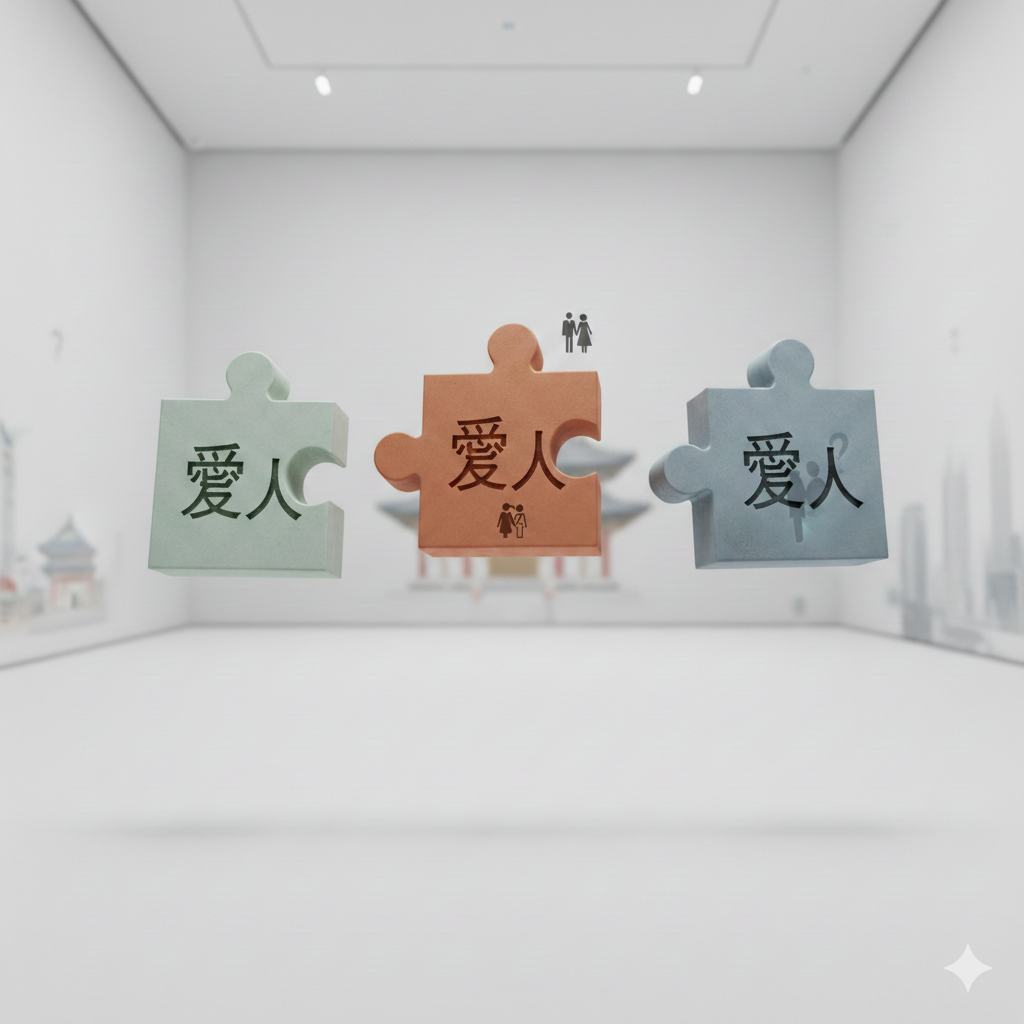
2. 愛人
This involves the characters for “love” and “person,” but the relationship status changes per country.
- In Korea (Ae-in): Refers to a boyfriend or girlfriend.
- In China (àiren): Specifically means your legal spouse (husband or wife).
- In Japan (Aijin): Use this with extreme caution! It often implies a secret lover or someone involved in an extramarital affair.
3. 八方美人
Literally “a beauty from eight directions” (an all-around beauty).
- In Korea (Pal-bang-mi-in): A high compliment. It refers to a “Renaissance man/woman” or a multi-talented person who excels at everything.
- In Japan (Happo-bijin): A subtle insult. It describes someone who tries to please everyone and, as a result, is seen as two-faced or lacking a backbone.
- The Trap: Calling your Japanese colleague a Happo-bijin to praise their versatility might actually suggest you think they are untrustworthy.
4. 割愛
This poetic phrase literally means “to part with something you love.”
- In Korea (Hal-ae): Mostly used in the context of time or effort. If you “allocate” (hal-ae) time for a guest, it’s a gesture of respect.
- In Japan (Katsual): Used when omitting or cutting something. If a speaker says they will katsuai a part of their presentation, they are skipping it to save time, not necessarily because they “love” that slide.
- In China (gē’ài): Usually refers to giving up a physical prized possession or a romantic interest for the sake of someone else.
5. 差別
- In Korea & Japan: A heavy word meaning “discrimination”—social or systemic unfairness.
- In China (chābié): A neutral, technical term for “difference” or “disparity.”
- The Trap: If a Chinese partner points out the chābié between two contracts, they are just asking for a comparison of terms, not accusing you of bias.
6. 大丈夫
- In Korea & China (dàzhàngfu): Describes a “great man”—someone heroic, manly, and full of integrity.
- In Japan (Dai-jo-bu): A ubiquitous phrase meaning “It’s okay” or “I’m fine.”
Why the Divide?
How did this happen? It’s a fascinating mix of historical evolution. Korea often preserved the classical, formal meanings; Japan shifted the context to fit local social nuances (like the Japanese value of harmony leading to the Happo-bijin shift); and China modernized many characters toward practical, everyday usage.
The Takeaway
For professionals and expats working across the “CJK” sphere, these nuances are more than just trivia—they are the key to Cultural Literacy. Understanding that the same symbol can carry a compliment in one country and an insult in another is the first step toward truly mastering the Asiatic angle.
Have you ever had a “lost in translation” moment while using Hanja or Kanji? Share your stories in the comments below!
Leave a Reply