
1. Introduction: A Modern Feudal System Wearing the Mask of Democracy
Japan is a developed nation that outwardly embraces Western-style democracy.
Yet beneath the surface, its political trajectory is strikingly different from that of South Korea or the Western world.
Living in Yokohama, I’ve come to feel that Japanese politics is less about choice and more about custom—less about dynamism and more about permanence.
Political change here feels evolutionary at best, never revolutionary.
Why has Japanese democracy taken such an unusual path?
2. Voluntary One-Party Dominance: The Trap Called “Stability”
Since its founding in 1955, Japan’s Liberal Democratic Party (LDP) has ruled almost continuously for nearly 70 years.
This dominance wasn’t enforced—it was chosen.
The key lies in the LDP’s unique structure: a big-tent party powered by factional politics.
Power shifts within the party, not between parties
The LDP is not ideologically monolithic. It absorbs everyone from hardline conservatives to relatively progressive moderates.
When voters desire change, they don’t replace the ruling party—they replace factions inside the LDP.
For voters, this feels like a safer bet:
Why gamble on an untested opposition when you can get a “controlled variation” within the ruling party?
A perpetually fragmented opposition
Japan’s parliamentary system makes unity essential for opposition parties. Yet opposition forces remain divided, unable to form a coherent alternative.
Each party fights for survival on its own, inadvertently reinforcing the LDP’s dominance.
3. The Fear of “No Alternative”: Trauma from the Democratic Party Era
The single biggest reason Japanese voters hesitate to abandon the LDP is the traumatic memory of the Democratic Party of Japan (DPJ) government from 2009 to 2012.
For many, that period represents a national cautionary tale.
Economic turmoil
In the aftermath of the global financial crisis, weak policy responses and a historically strong yen devastated export-driven industries.
Diplomatic humiliation
During the Senkaku Islands dispute, China’s suspension of rare-earth exports exposed Japan’s strategic vulnerability and government paralysis.
The final blow: the 3.11 disaster
The DPJ’s indecisive response to the 2011 earthquake, tsunami, and nuclear crisis etched a lasting impression:
“If we entrust the country to the opposition, the state itself may be at risk.”
That fear still lingers.
4. Political Aristocracy and Inherited Territories: The Three Sacred Assets
Perhaps the most defining feature of Japanese politics is its hereditary nature.
Political office is often treated as a family business, with electoral districts passed down like feudal landholdings.
This system is sustained by the so-called “Three Sacred Assets”:
- Jiban (地盤) – an inherited local support network
- Kanban (看板) – family name recognition
- Kaban (鞄) – financial resources for campaigns
Together, they form an almost impenetrable barrier to newcomers.
Iconic cases of political inheritance
- Shinzo Abe: grandson of former Prime Minister Nobusuke Kishi and son of Shintaro Abe, epitomizing dynastic politics.
- The Koizumi family: Junichiro Koizumi was a third-generation politician; his son Shinjiro—famous for the phrase “Fun, Cool, Sexy”—is now a fourth-generation lawmaker who inherited the same electoral stronghold.
For outsiders, these districts are effectively closed castles.
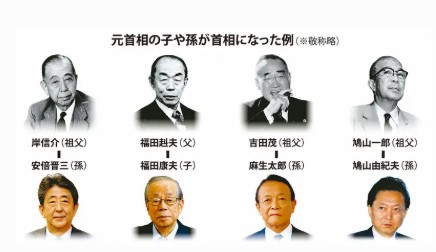
Examples of Hereditary Prime Ministers in Japan
5. The Rise of Sanae Takaichi: A Non-Dynastic Rebellion
Against this backdrop, the surge in popularity of Prime Minister Sanae Takaichi is no mystery.
She is a non-hereditary politician—a rarity in Japanese politics.
She inherited no district, no famous name, no financial machine.
That alone makes her revolutionary.
To voters—especially younger generations weary of political aristocracy—her ascent symbolizes liberation.
The narrative of “a leader who rose by competence rather than bloodline” has become one of the most powerful political stories in Japan today.
6. Conclusion: Is Change Finally Coming?
The LDP’s historic losses in the 2025 House of Councillors election suggest visible cracks in Japan’s 70-year political order.
Yet as long as the opposition remains fragmented and the hereditary system intact, genuine transformation will be slow.
Whether Takaichi represents a temporary anomaly or the beginning of a shift from aristocratic politics to civic politics remains to be seen.
From the streets of Yokohama, I’ll be watching closely as this long-awaited chapter of change begins—quietly, as it always does in Japan.
Leave a Reply