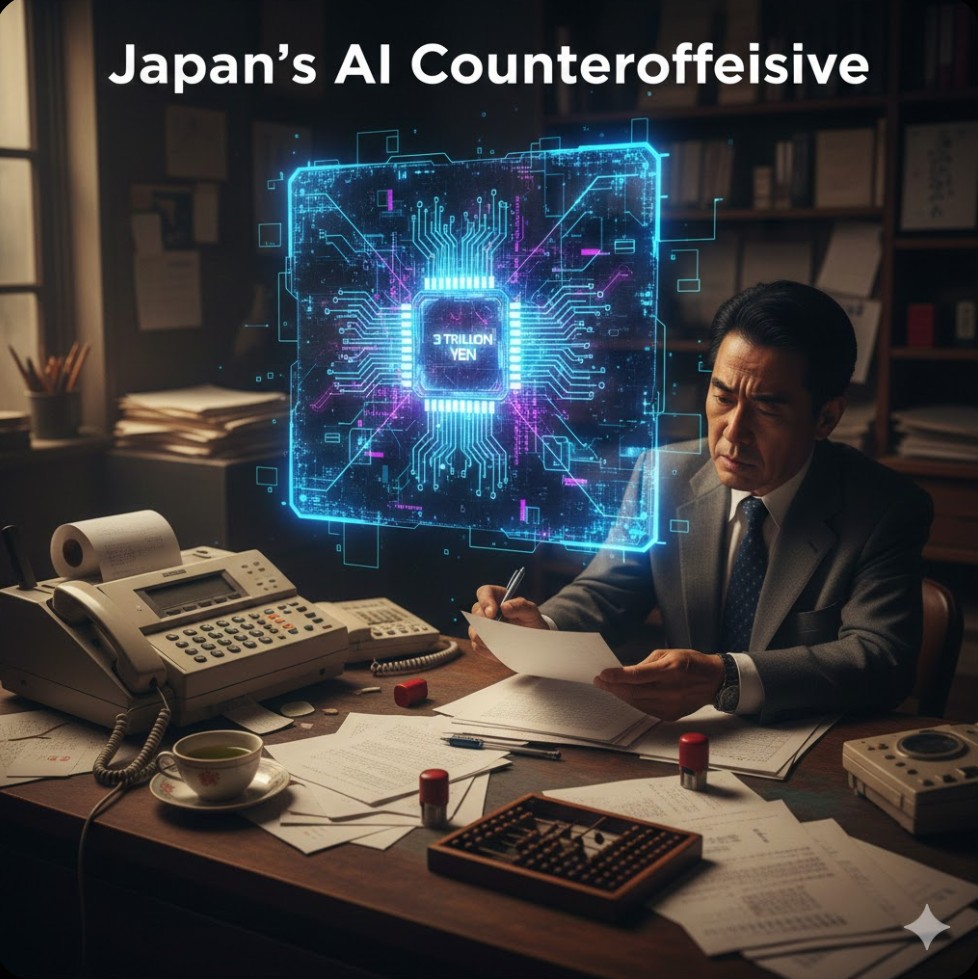
Living and working in Japan for the past eight years as an expat, I’ve noticed a strange paradox. While the world sees Japan as a land of faxes and hanko stamps, the government is currently in the midst of a desperate, all-out “AI Total War.”
After missing the boat on the internet revolution due to the post-bubble “Lost Decades,” Japan sees the AI revolution not just as a tech trend, but as its final lifeline. But as someone on the ground, I see a massive wall that 3 trillion yen might not be able to climb.
1. The Data: “Corporations are Driving the Bus”
Japan’s AI adoption looks very different from South Korea’s. While Korea led with high individual literacy and consumer-facing AI (B2C), Japan is moving through B2B and Public Sectors.
- The Surge: Adoption among Japanese enterprises has surpassed 40% in 2026, closing the gap with the OECD average.
- Survival Over Innovation: In Japan, AI is a necessity for societal survival due to a shrinking workforce. It’s about keeping factories running when there are no more humans left to do the job.
2. The “Hardware Obsession”: Living on an Old Pension
The Japanese government recently increased its AI and semiconductor budget to a staggering 3 trillion yen (approx. $20 billion USD). They are betting heavily on “Physical AI” and domestic chip production (the Rapidus project).
The truth is, Japan has transitioned from a manufacturing powerhouse into a “Rentier State.” They live off the interest and dividends of the massive overseas assets they acquired in the 80s. This 3-trillion-yen bet is a desperate attempt to convert that old “physical wealth” into “digital capital” before the pension runs out.
3. The Real Barrier: “Meiwaku” vs. Speed
The biggest obstacle isn’t the budget; it’s the management culture. I recently experienced this firsthand.
I asked my manager to streamline the approval process for a Korean client who demands high speed. My new CEO (from a Chinese background) immediately agreed, saying he was already working on it. However, my Japanese middle manager hesitated, replying:
“I understand, but you tend to make small mistakes. We need an extra layer of checks because I can’t oversee everything, and we cannot cause ‘Meiwaku’ (trouble) for others.”
In the world of AI, speed is everything. 99% accuracy at light speed is often better than 100% accuracy after three weeks of bureaucracy. But in Japan, the fear of “Meiwaku”—the obsession with avoiding even the smallest inconvenience to others—acts as a massive brake on innovation.
4. The “Galapagos” Risk: Trillions for a Ferrari in a Traffic Jam
Japan is building a 3-trillion-yen “AI Ferrari” (hardware), but the corporate culture is a permanent traffic jam of “extra checks” and “careful decision-making.”
- The Talent Gap: As of 2026, AI specialists per 100,000 people in South Korea is over 12 times higher than in Japan.
- The Decision Gap: While competitors are failing fast and pivoting, Japan is still printing out 20-page papers to discuss “how to use a chatbot.”
Final Thoughts: The Choice
Japan’s 20th-century miracle was a product of perfect timing—growing in a sandbox protected by the US with no regional rivals like Korea or China in sight. Today, they are trying to use that same 1980s playbook in a 2026 world.
Whether Japan wins its AI bet depends on whether it can burn down its “Zero-Mistake” culture. As an expat, my strategy is simple: Invest the stability of the ‘Old Japan’ into the growth of the ‘New Digital World.’ Whether the train reaches the station or not, I’m making sure my own portfolio is on the right track.
Leave a Reply